Country Lifestyle Destinations USA: A Guide to Rural Relocation
The concept of rural and semi-rural living in the United States has undergone a profound structural shift over the past two decades. What once existed primarily as an option dictated by agricultural necessity or retirement has transformed into a deliberate, multifaceted lifestyle choice for a diverse demographic. This migration toward less densely populated regions is not merely a reactionary flight from urban environments; it represents a calculated reassessment of how geographic space, local economies, and personal autonomy intersect.
Navigating this transition requires a sophisticated understanding of the varied landscapes that define the modern American interior. The term “country living” encompasses an expansive spectrum of geographic, cultural, and economic realities. A homestead in the high desert of New Mexico demands an entirely different set of operational, financial, and logistical considerations than a historic farmhouse in the Hudson Valley or a timber-rich acreage in the Pacific Northwest. Failing to recognize these distinctions often leads to significant misalignment between an individual’s expectations and the systemic realities of rural infrastructure.
Developing a long-term strategy for identifying and settling into these regions requires moving past idealized, marketing-driven narratives. True sustainability in a rural context depends on analyzing regional economic resilience, local governance structures, environmental vulnerabilities, and the inherent trade-offs of localized supply chains. This article serves as an exhaustive, editorially rigorous framework designed to analyze the structural dynamics of rural relocation, offering a definitive blueprint for evaluating regional viability across the United States.
Understanding “Country Lifestyle Destinations USA”
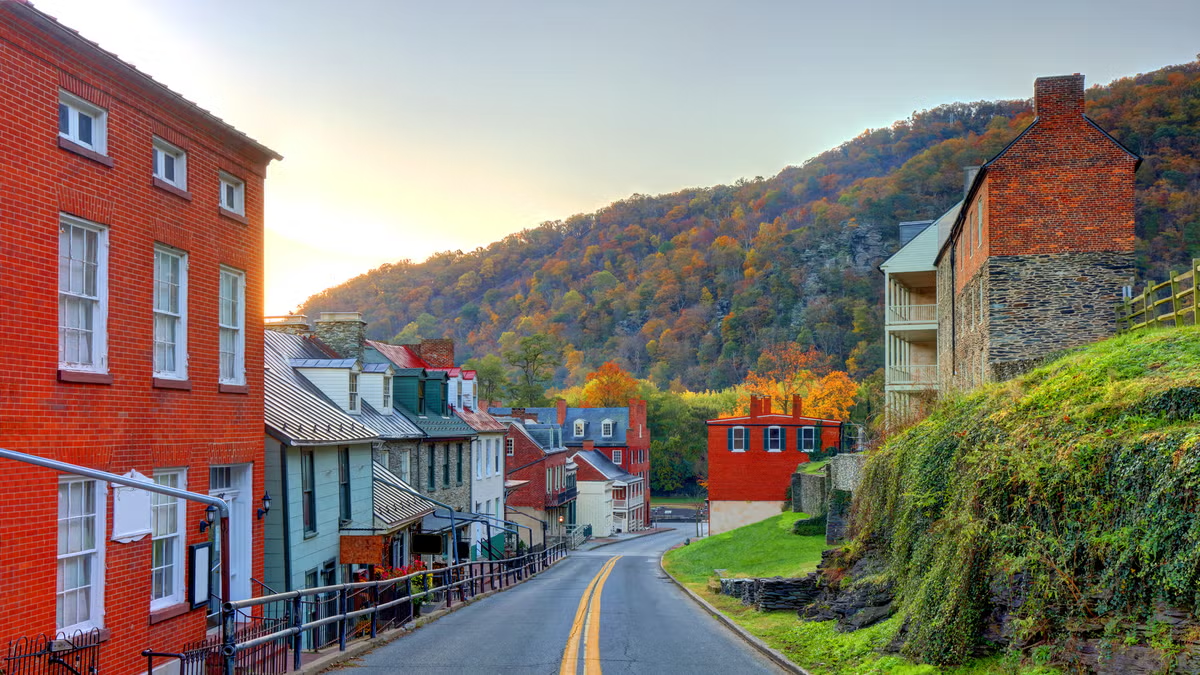
The phrase country lifestyle destinations usa represents a complex matrix of geographic variables, socioeconomic conditions, and infrastructural realities rather than a singular, monolithic category. At its core, the term describes regions outside major metropolitan statistical areas (MSAs) that possess the natural resources, cultural density, and civic infrastructure necessary to support long-term residential settlement without requiring full-scale participation in traditional agricultural industries.
A frequent error in analyzing these destinations is the tendency to flatten distinct ecosystems and economies into a generic concept of “the countryside.” This oversimplification obscures the massive operational differences between a tourist-dependent mountain enclave, an active agricultural county, and a post-industrial rural town undergoing economic revitalization. Each of these profiles carries distinct tax structures, zoning restrictions, and community dynamics that directly impact property rights and daily operations.
Furthermore, evaluating these destinations solely through an aesthetic lens risks ignoring the baseline infrastructure required to sustain modern life. Access to level-3 trauma centers, reliability of localized electrical grids, water rights availability, and the resilience of digital connectivity vary drastically across state lines and county jurisdictions. True viability relies on a balance between isolation and accessibility, ensuring that a property can operate independently while remaining integrated into wider regional supply chains.
The Structural Evolution of Rural American Landscapes
The contemporary landscape of country lifestyle destinations usa is the product of long-term historical, economic, and technological shifts. The initial baseline of rural American settlement was established by extractive and agrarian economies throughout the nineteenth and early twentieth centuries. This phase created the foundational layout of small towns, rail corridors, and county seats that continue to structure the geography of the American interior today.
The mid-twentieth century brought widespread industrialization of agriculture and the expansion of the Interstate Highway System, which triggered a dual effect. Many strictly commodity-dependent agricultural zones experienced steady population declines as automation reduced the need for manual labor. Conversely, rural areas within a two-hour radius of major metropolitan centers transformed into exurban corridors, absorbing outward residential growth while retaining elements of their rural character.
| Era | Primary Economic Driver | Infrastructural Catalyst | Demographic Trend |
| Late 19th Century | Agrarian expansion, resource extraction | Railroad networks, Homestead Acts | Dispersed rural settlement, growth of market towns |
| Mid-20th Century | Industrial agriculture, manufacturing | Interstate Highway System | Depopulation of remote areas, exurban development |
| Early 21st Century | Knowledge economy, tourism, recreation | Broadband expansion, remote work models | Selective decentralization, high-amenity rural influx |
In the current era, the widespread availability of high-speed satellite broadband and decentralized professional models has separated geographic location from traditional employment hubs. This technological shift has altered the demographic profile of rural inflows, bringing in capital-dense households that place new demands on local infrastructure, housing markets, and civic services. The resulting friction between historical residents and new arrivals is a defining feature of the modern rural landscape, shaping local politics, land-use battles, and zoning reforms across the nation.
Analytical Frameworks for Regional Evaluation
To objectively assess the viability of various country lifestyle destinations usa, buyers and investors cannot rely on intuition alone. They require structured mental models that quantify the hidden liabilities and operational realities of rural properties.
The Infrastructural Isolation Index (III)
The Infrastructural Isolation Index measures the relationship between a property’s physical privacy and its distance from critical public services. This framework evaluates three primary vectors:
Where:
-
$D_{\text{trauma}}$ represents the travel time in minutes to a Level 1 or Level 2 trauma center.
-
$D_{\text{supply}}$ represents the travel time to specialized parts, agricultural supplies, and industrial hardware.
-
$D_{\text{muni}}$ represents the distance to the nearest municipal boundary maintaining year-round public roads.
A high III score indicates a property that offers maximum seclusion but requires significant on-site redundancy, including backup power generators, extensive fuel storage, heavy equipment for snow removal or road repair, and advanced medical first-aid capabilities.
The Ecological Carrying Capacity Framework
This model evaluates a destination’s long-term environmental sustainability by looking past current weather patterns to analyze systemic resource constraints:
-
Hydrological Security: Assessing the legal status of water rights (prior appropriation vs. riparian doctrine) and the historical drawdown rates of local aquifers.
-
Biomass Risk Matrix: Quantifying the surrounding forest or grassland fuel load, historical fire return intervals, and the physical defensibility of the home site.
-
Climatic Stress Resistance: Evaluating how local infrastructure responds to sustained temperature extremes, including grid stability during prolonged freezes or heat waves.
The Geopolitical Jurisdiction Matrix
Properties do not exist in a vacuum; they are governed by layered regulatory frameworks. This framework maps out the friction between county zoning ordinances, state-level tax policies, and federal land management.
-
Federal Land Boundaries: Bureau of Land Management (BLM) or United States Forest Service (USFS) regions impact access, wildfire liability, and seasonal grazing rights.
-
State Tax and Legal Framework: Determines water law doctrines and available property tax relief programs for managed land.
-
County Zoning and Covenants: Establishes localized Right-to-Farm laws, infrastructure set-backs, and short-term rental bans.
A property bordering a National Forest offers unparalleled privacy, but it also exposes the owner to federal land management decisions, prescribed burns, and public access issues that fall entirely outside county control.
Typologies of Rural and Semi-Rural Destinations
Evaluating country lifestyle destinations usa requires breaking them down into distinct, functional categories. Each archetype features specific economic drivers, infrastructure considerations, and community dynamics.
High-Amenity Mountain Corridors
Characterized by dramatic topography, public land access, and a high concentration of recreational options, these regions include areas like the Mountain West, the southern Appalachian chain, and portions of the northern Cascades.
-
Advantages: High property appreciation, reliable municipal services, robust tourism-driven economies.
-
Trade-offs: Extreme cost per acre, strict environmental zoning, severe wildfire exposure, seasonal traffic congestion.
Historic Agrarian River Valleys
These areas, found throughout the mid-Atlantic, parts of New England, and the upper Midwest, are defined by fertile soil, historic town centers, and established small-scale farming operations.
-
Advantages: Stable water resources, proximity to major cultural markets, established local food networks.
-
Trade-offs: High property taxes, restrictive historic preservation laws, aging municipal infrastructure.
Coastal Plains and Maritime Lowlands
Stretching along the Southeastern seaboard, the Gulf Coast, and parts of the Pacific Northwest coastline, these destinations mix rural privacy with access to marine environments.
-
Advantages: Long growing seasons, moderate winters, diverse recreational fishing and boating opportunities.
-
Trade-offs: High humidity, hurricane or severe storm exposure, rapidly rising flood insurance premiums, high soil salinity limiting agriculture.
High Desert and Arid Basins
Encompassing large swaths of the American Southwest, these regions attract buyers drawn to vast horizons, clear air, and distinct architecture.
-
Advantages: Affordable land, minimal biomass fire risk, low humidity, clear night skies for astronomy.
-
Trade-offs: Severe water scarcity, extreme temperature swings, long distances to medical care, heavy reliance on complex solar and well systems.
Midwestern Timber and Lake Districts
Located throughout the upper Great Lakes region and parts of the Ozarks, these landscapes feature dense forests, glacial lakes, and small, resource-focused towns.
-
Advantages: Plentiful fresh water, affordable acreage, strong hunting and fishing traditions.
-
Trade-offs: Severe winters, shorter growing seasons, limited economic diversity outside of timber and seasonal tourism.
Pastoral Piedmont and Foothill Regions
The rolling transition zones between plains and mountains, such as the Virginia Piedmont, the Texas Hill Country, and the California foothills, offer a balanced landscape profile.
-
Advantages: Moderate topography, diverse microclimates, solid balance between rural privacy and exurban accessibility.
-
Trade-offs: Rapid exurban sprawl, complex water runoff management issues, variable soil depth for building foundations.
Regional Comparison Matrix
| Typology | Water Security | Capital Expenditure (CapEx) Risk | Regulatory Friction | Community Dynamics |
| High-Amenity Mountain | Moderate | High (Wildfire/Snow) | High (HOA/Environmental) | Transient/Seasonal |
| Agrarian River Valley | High | Moderate (Historic Upkeep) | High (Historic/Zoning) | Established/Generational |
| Coastal Lowlands | High (Quality Risks) | High (Storm/Corrosion) | Moderate | Mixed Resident Base |
| High Desert Basin | Critical | High (Off-Grid/Solar) | Low | Independent/Isolated |
| Lake & Timber District | Exceptional | Moderate (Winter Prep) | Low to Moderate | Generational Local |
| Pastoral Piedmont | Moderate to High | Moderate | Moderate (Growth Control) | Rapidly Shifting |
Decision Logic: Matching Profiles to Capacity
Choosing between these typologies requires an honest assessment of available capital and operational capacity. An individual unwilling to manage complex mechanical systems should avoid off-grid desert configurations, regardless of how attractive the landscape is. Similarly, those seeking complete privacy and freedom from regulation must look past high-amenity mountain corridors, where strict county ordinances and Homeowners Associations (HOAs) frequently limit property use.
Operational Realities: Scenario-Based Analysis
The practical realities of settling into country lifestyle destinations usa are best understood by analyzing specific, real-world scenarios. These examples highlight the operational requirements, unexpected friction points, and long-term costs that define rural land ownership.
Scenario A: The Remote-Work Homestead in Northern New England
A couple relocates to a 40-acre wooded parcel in Vermont to work remotely while managing a small homestead.
-
The Reality: Within six months, they discover that their 1,500-foot unpaved driveway requires a dedicated tractor with a commercial-grade snowblower attachment, a $35,000 unplanned capital expenditure.
-
Failure Mode: A late-autumn ice storm downs trees along a two-mile private easement, severing physical access and overhead power lines. Because they are at the end of a rural utility circuit, power restoration takes nine days. Without a dual-fuel backup generator tied directly to their propane system, the home’s pipes freeze, causing $50,000 in water damage.
-
Second-Order Effects: The lack of physical access prevents local fuel delivery trucks from refilling their primary heating tanks, forcing them to rely on wood heat alone for an extended period.
Scenario B: The Acreage Acquisition in the Texas Hill Country
An investor buys a 15-acre ranchette near Fredericksburg, Texas, planning to cultivate a boutique vineyard and host extended family.
-
The Reality: The property relies entirely on a well tapping into the Trinity Aquifer. Two years into ownership, regional drought triggers emergency pumping restrictions, and local agricultural drawdowns cause the static water level in their well to drop 80 feet.
-
Failure Mode: The existing 2-horsepower well pump burns out from running dry. Deepening the well by an additional 150 feet and installing a high-capacity pump costs $28,000. Additionally, the high total dissolved solids (TDS) and limestone content require an industrial water-softening and reverse-osmosis filtration array to protect the home’s plumbing and make the water usable for irrigation.
-
Second-Order Effects: The high salinity of the remaining water requires specialized soil amendments to prevent soil compaction and protect the roots of their newly planted vineyard.
Scenario C: The Pacific Northwest Timber Tract
A buyer purchases a 50-acre parcel of second-growth Douglas fir in western Oregon, seeking deep isolation and a sustainable lifestyle.
-
The Reality: The property is classified under a state forestland tax deferral program, which reduces property taxes by 85%. However, maintaining this classification requires strict adherence to a state-approved forest management plan, including mandatory invasive species control and pre-commercial thinning.
-
Failure Mode: The owner fails to clear a mandated 100-foot defensible space buffer around the primary structure. A lightning strike sparks a wildfire in the adjacent state park, and the fire uses the dense understory on the property to bypass local containment lines, destroying the home.
-
Second-Order Effects: Because the owner did not comply with the clear-space guidelines outlined in their insurance policy’s wildfire rider, the carrier denies the structural replacement claim, leaving them with the land debt but no home.
Economic Dynamics, Capital Allocation, and Resource Management
The financial model of a rural property is fundamentally different from that of an urban or suburban asset. In a suburban setting, property values are driven primarily by the structure itself and school district demand; infrastructure costs are socialized through municipal taxes. In country lifestyle destinations usa, the owner assumes direct responsibility for funding and maintaining vital infrastructure.
Direct vs. Indirect Cost Vectors
When building a budget for a rural property, capital must be divided into clear operational categories:
-
Subsurface Infrastructure: Well drilling, pump installation, casing, water testing, and multi-stage filtration arrays.
-
Waste Management: Septic tank installation, leach field engineering, and mandatory perk testing.
-
Access Corridors: Culvert engineering, gravel grading, ditch maintenance, and rights-of-way management.
-
Biomass Control: Annual brush clearing, tree trimming, and firebreak creation.
The Opportunity Cost of Specialized Labor
A major hidden expense in rural destinations is the lack of a dense, competitive service economy. If a specialized component—such as an inverter for a solar grid or a control board for a geothermal heat pump—fails, finding a certified technician willing to travel 60 miles to the property can take days and incur significant travel fees. Rural property owners must either pay a premium for specialized service or invest the time to master basic mechanical, electrical, and hydraulic troubleshooting themselves.
Financial Variability and Operational Horizons
| Asset Category | Baseline Capital Expenditure | Annual Maintenance Cost | Operational Lifespan | Primary Risk Vector |
| Deep Water Well System | $15,000 – $45,000 | $500 – $1,500 | 15 – 25 Years | Aquifer depletion, pump burnout |
| Engineered Septic Array | $8,000 – $25,000 | $300 (Every 3 years) | 20 – 30 Years | Soil compaction, root intrusion |
| Private Unpaved Access Road | $10 – $30 per linear foot | $1,000 – $5,000 | Permanent (with grading) | Heavy rain washouts, culvert failure |
| Off-Grid Solar/Battery Bank | $25,000 – $75,000 | $1,000 | 10 – 15 (Batteries) | Lighting strikes, inverter failure |
Tools, Strategies, and Support Systems
Successfully managing a large-scale rural property requires shifting from standard household tools to specialized, industrial-grade equipment. The list below outlines the core tools required to maintain a country property effectively.
-
Compact Utility Tractor (40–60 HP, Four-Wheel Drive): Necessary for moving bulk material, grading access roads, clearing snow, and clearing brush. Limitation: High initial cost ($30,000–$60,000); requires basic mechanical skills to service hydraulic lines.
-
Dual-Fuel Standby Generator (15kW–22kW) with Automatic Transfer Switch: Provides seamless power during grid outages by running on propane or diesel. Limitation: Requires professional installation and regular fuel supply monitoring.
-
Commercial-Grade Chainsaw Array (50cc and 70cc engines): Vital for clearing fallen trees across access roads and managing fuel loads. Limitation: Requires strict adherence to safety protocols and regular chain sharpening.
-
Tow-Behind Rotary Cutter (“Bush Hog”): Clears brush, saplings, and heavy weeds to maintain firebreaks and pastures. Limitation: Can throw debris and damage tractor power take-off (PTO) shafts if it hits hidden rocks.
-
Professional Brushcutter: Clears steep banks, fence lines, and areas around structures where tractors cannot reach. Limitation: Physically demanding to operate for long periods.
-
Debris Chipper/Shredder (PTO-driven or standalone): Converts cleared brush into usable mulch, reducing the need for large burn piles. Limitation: Prone to jamming if fed wet, fibrous material like willow or vine maple.
-
Backpack Wildfire Fire-Suppression Pump (5-gallon minimum): Provides immediate water delivery for spot fire suppression or controlling prescribed burns. Limitation: Limited capacity; only effective against small, early-stage fires.
Risk Landscape and Systemic Failure Modes
The transition to country lifestyle destinations usa introduces unique risks that rarely occur in more populated environments. These risks can cascade, turning a single unexpected event into a major logistical and financial challenge.
-
Primary Climatic Event: For example, an extended sub-zero freeze grips a region unaccustomed to prolonged cold weather.
-
Secondary Utility Failure: Systemic power grids collapse under load. Because rural circuits serve lower population densities, utility companies prioritize them last for repair crews.
-
Tertiary Mechanical Cascade: Without electrical grid power, insulated well houses rely entirely on localized backup heat. If backup systems fail to engage, well casings, inline pressure tanks, and sediment filters freeze and rupture, severing all domestic water delivery.
-
Quaternary Logistical Block: Heavy localized ice or unplowed shared access roads prevent plumbing supply trucks or independent repair technicians from physically reaching the property. The system failure remains absolute until regional thaw cycle timelines allow for mechanical transit.
This chain of dependencies illustrates how a single weather event can trigger a series of failures across vulnerable rural systems. Mitigating these risks requires maintaining multiple redundancies, including alternative heating options, manual overrides for electric pumps, and on-site spare parts for critical machinery.
Long-Term Governance and Property Maintenance
Unlike a suburban property where public works departments handle external infrastructure, managing rural acreage requires structured, proactive planning. This approach prevents minor maintenance needs from turning into costly emergency repairs.
Operational Protocols: The Layered Inspection Routine
Weekly Tasks
-
Check well house interior temperatures during freezing weather.
-
Visually inspect perimeter fencing for damage from fallen limbs or wildlife.
-
Confirm generator fuel levels and verify that the automatic exercise cycle ran successfully.
Monthly Tasks
-
Inspect tractor and heavy machinery fluid levels, battery health, and tire pressure.
-
Check culvert inlets and outlets for debris buildup ahead of major rainstorms.
-
Test water filtration system pressure gauges to determine if filter changes are required.
Bi-Annual Tasks
-
Clear brush and grass within a 30-foot radius of all primary structures.
-
Clean out gutters and roof valleys to remove dry leaves and pine needles.
-
Service chainsaws, change engine oil on utility vehicles, and grease grease points on tractor implements.
Annual Tasks
-
Schedule a professional inspection and pumping of the septic tank (adjust frequency based on household size).
-
Conduct a comprehensive chemical and bacterial analysis of well water.
-
Clear encroaching tree limbs along the entire length of private access roads to ensure emergency vehicle clearance.
Measurement, Tracking, and Evaluation
Managing a sophisticated rural property requires tracking key operational indicators over time. This data acts as an early warning system, highlighting structural or environmental issues before they cause system failures.
Quantifiable Operational Indicators
-
Static Well Level and Drawdown Rate: Measure this annually during the driest month. A consistent drop in the static water level indicates regional aquifer stress or well degradation, signaling the need to budget for well deepening.
-
Fuel Consumption Rates: Track gallons of propane, diesel, or cords of wood used per heating degree day. Sudden increases point to insulation breakdown, heating system inefficiencies, or compromised fuel lines.
-
Soil Chemistry Profiles: For managed pastures, orchards, or large gardens, run annual soil tests to track pH, organic matter content, and nutrient depletion. This guides targeted fertilizer and lime applications.
-
Incoming Electrical Line Voltage: Monitor this using a digital multimeter at the main transfer switch during peak regional demand periods. Consistent drops below 210V can damage sensitive electric pump motors and HVAC compressors, requiring the installation of whole-house voltage regulators.
Qualitative Integrity Signals
-
Access Road Erosion Patterns: Watch for the formation of small channels or soft spots along gravel driveways after heavy rains. Addressing these early with crushed rock and proper grading prevents full-scale road washouts.
-
Changes in Forest Understory: A sudden rise in dead standing timber or invasive brush increases the surrounding fuel load, signaling that it is time to prioritize brush clearing and forest management.
-
Changes in Well Water Taste or Clarity: Any sudden increase in turbidity (cloudiness), sulfur odors, or iron staining indicates structural changes in the aquifer or a breach in the well casing, requiring immediate testing and system flushing.
Deconstructing Prevalent Rural Myths
The growing interest in country lifestyle destinations usa has fueled several oversimplified assumptions about what it takes to live outside urban areas. Debunking these myths is essential for establishing realistic expectations.
1: Rural living is inherently less expensive than urban or exurban living.
-
Correction: While the initial cost per acre is often lower, the capital required to build and maintain independent infrastructure (wells, septic systems, private roads) can offset those savings. Additionally, fuel costs, equipment maintenance, and higher property insurance premiums in high-risk zones can create a surprisingly expensive baseline budget.
2: Buying rural land guarantees the right to use it as you see fit.
-
Correction: County zoning laws, agricultural conservation easements, historic preservation rules, and water rights doctrines frequently place strict limits on land use. In many western states, owning the surface land does not grant ownership of the minerals beneath it or the right to collect rainwater falling on the roof.
3: Modern satellite internet eliminates all remote work challenges in rural areas.
-
Correction: While high-speed satellite options have transformed remote work, heavy tree canopy, extreme storms, and localized power outages can still disrupt service. True professional reliability requires secondary backups, such as a cellular hotspot array connected to an external antenna.
4: Local “Right-to-Farm” laws protect homeowners from all neighborhood nuisances.
-
Correction: Right-to-Farm ordinances are designed to protect established commercial agricultural operations from complaints brought by new residential neighbors. They do not protect a residential homeowner from the dust, odors, noise, or chemical spraying of an adjacent industrial farm.
5: Any rural property can easily support livestock or subsistence agriculture.
-
Correction: Sustainable livestock management depends heavily on soil quality, forage availability, and water access. A rocky parcel in an arid basin or a heavily shaded clearing in a dense pine forest may require extensive, expensive soil amendments and supplemental feed purchases to support any animals.
6: Rural communities are naturally welcoming to anyone seeking a simpler life.
-
Correction: Integration into rural areas takes time and a willingness to listen. Inflows of affluent buyers can drive up local real estate taxes and housing costs, pricing out generational residents. Newcomers who join local boards and immediately demand urban-style services often face community resistance.
Ethical, Ecological, and Community Considerations
Relocating to country lifestyle destinations usa comes with a responsibility to understand your impact on the local community and environment. The influx of new residents and capital can alter the economic and social dynamics of small towns, creating several important challenges:
-
Housing Market Displacement: Rising property values often outpace local wages, making it difficult for essential workers, teachers, and agricultural laborers to afford housing in the communities they serve.
-
Strained Public Resources: Volunteer fire departments, rural search-and-rescue teams, and small county clinics can quickly become overwhelmed by a growing population that expects urban-level emergency response times.
-
Ecosystem Fragmentation: Dividing large, continuous parcels of land into smaller residential tracts can disrupt wildlife migration corridors, increase wildlife-human conflicts, and strain local water tables.
True integration requires a mindful approach. Sustainable land management, supporting local businesses, and volunteering for civic organizations help ensure that your move contributes positively to the preservation and resilience of your new home.
Synthesis and Long-Term Outlook
The enduring appeal of country lifestyle destinations usa is rooted in a desire for greater autonomy, connection to the natural world, and physical privacy. However, achieving a sustainable rural lifestyle requires moving past romanticized ideals and taking an analytical approach to land management.
Long-term success depends on a clear understanding of infrastructure requirements, environmental dynamics, and the financial reality of maintaining a large property. The owners who thrive are those who approach their land not as passive observers, but as active managers. They understand their property’s mechanical systems, respect the limits of local ecosystems, and build strong connections within their local communities.
As technology continues to decouple work from traditional urban centers, the migration toward the American interior will likely continue to reshape the country’s social and economic geography. Navigating this landscape successfully requires careful research, practical preparation, and an ongoing commitment to learning the realities of rural life.