Top Luxury Estates in America: An Institutional Asset Management Guide
The landscape of ultra-high-net-worth (UHNW) real estate in the United States is frequently reduced to a sequence of record-breaking transactional headlines. These reports focus heavily on glossy visual portfolios. However, this surface-level framing routinely mischaracterizes the nature of these properties. Consequently, it treats a structurally complex, multi-layered asset class as a mere collection of expansive floor plans and premium geographic coordinates. In reality, evaluating the top luxury estates in america requires a highly analytical lens. This perspective must account for historical zoning frameworks, localized ecological risk profiles, municipal governance structures, and the immense operational realities required to preserve these multi-generational physical assets.
The acquisition and long-term stewardship of these trophy properties involve intricate capital dynamics. These financial requirements go far beyond the initial purchase price. For instance, each regional ecosystem imposes distinct structural and operational conditions, from the microclimates of coastal California to the heavily restricted historical footprints of the Northeast. Therefore, understanding these properties demands a deeper investigation into how architectural ambition interacts with modern engineering constraints. Furthermore, analysts must evaluate shifting tax regimes and evolving expectations surrounding absolute structural privacy and ecological resilience.
This analysis provides a definitive framework for evaluating the top luxury estates in america. By moving beyond marketing nomenclature, it dissects the structural underpinnings, cost realities, governance models, and systemic vulnerabilities inherent to ultra-prime residential real estate. Ultimately, this document serves as an operational baseline for the family office, the institutional advisor, or the preservation-minded real estate strategist. It delivers the precise insights needed for assessing value, managing vulnerability, and executing long-term asset adaptation.
Understanding “top luxury estates in america”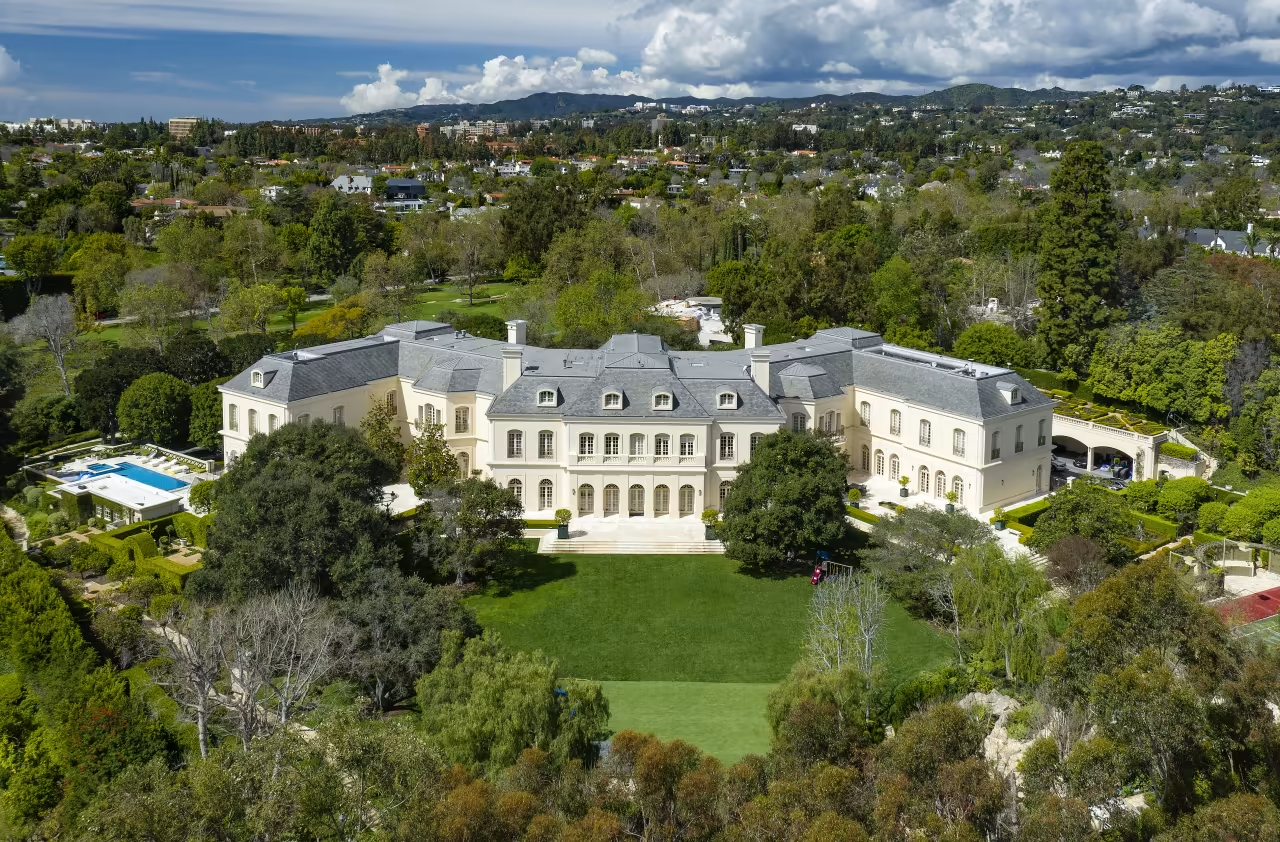
To systematically evaluate the top luxury estates in america, one must dismantle the generic marketing definitions of “luxury.” In the ultra-prime residential sector, asset tiering cannot be determined solely by a baseline price per square foot or standard luxury finishes. Instead, the market is fundamentally segmented into entry-level luxury, ultra-luxury, and institutional-grade trophy assets. Each of these tiers is governed by completely distinct liquidity patterns and valuation mechanics.
Common misunderstandings occur when market analysts apply standard residential valuation models to properties that possess true structural or geographical exclusivity. For example, a standard appraisal relies heavily on recent comparable sales within a narrow geographic radius. However, an estate featuring non-reproducible assets defies standard linear comparisons. These unique features might include deep-water yacht dockage in a protected Palm Beach basin, or historical Gilded Age entitlements in the Adirondacks. Therefore, the value of these estates is structurally coupled with their scarcity and the specific capital preservation goals of UHNW buyers. These individuals often view these assets as safe havens against inflation and market volatility.
Oversimplification risks are particularly acute when assessing liquidity. The broader residential real estate market reacts predictably to interest rate adjustments and domestic employment data. Conversely, the true trophy asset sector operates on an independent cycle driven by global liquidity, corporate equity event horizons, and sovereign wealth allocation shifts. Attempting to trade or value these estates without understanding the underlying holding structures leads to inaccurate risk models. Specifically, these assets often involve layered limited liability companies (LLCs) and blind trusts designed to obscure ultimate beneficial ownership, which creates flawed capital projections.
Deep Contextual Background
The institutional-grade residential estate market in the United States evolved along a distinct historical trajectory. It transitioned steadily from the concentrated industrial wealth of the late nineteenth century to the decentralized, technology-driven capital of the twenty-first century. During the Gilded Age, estates were constructed as overt monuments to corporate consolidation. These properties were concentrated in highly accessible corridors like New York’s Hudson Valley, Newport, and the Gold Coast of Long Island. Furthermore, they relied on massive arrays of cheap domestic labor and basic structural technologies. As a result, architects focused their energy on historicist aesthetics imported directly from European aristocratic traditions.
The mid-twentieth century introduced major structural shifts. This era was driven by the expansion of the interstate highway system, the rise of commercial aviation, and the widespread adoption of advanced mechanical systems. Specifically, climate control transformed the industry. These advancements unlocked geographic regions that were previously uninhabitable for year-round luxury living. Consequently, the dramatic rise of South Florida, the desert enclaves of the Southwest, and the mountain corridors of Colorado transformed architectural requirements. The design philosophy pivoted away from stone-masonry defensive compounds. Instead, builders embraced sprawling horizontal layouts designed to integrate seamlessly with the natural landscape.
In the contemporary era, this evolution is defined by a shift toward absolute privacy, technical self-reliance, and acute environmental awareness. The modern trophy estate is no longer merely a venue for public display. Instead, it functions as a highly secure, technologically complex sanctuary designed to operate independently of public infrastructure if necessary. This shift is structurally reflected in the rapid integration of advanced home automation. Furthermore, it incorporates sophisticated wellness infrastructure, independent energy storage grids, and hard-target security architectures engineered directly into the primary building shell.
Conceptual Frameworks and Mental Models
Evaluating these premium physical assets requires specialized cognitive models. These frameworks must account for the intersection of capital, geography, and time. Standard consumer models fail when applied to assets of this magnitude.
The Triple-Exclusivity Moat
True asset insulation in the ultra-prime real estate market is determined by the intersection of three non-reproducible variables:
-
Geographic Uniqueness: This includes entitlements or topological features that cannot be legally or physically replicated. For example, direct oceanfront acreage with grandfathered coastal setbacks provides immense insulation.
-
Architectural Irreplaceability: This involves structural execution requiring artisanal masonry, historic materials, or specialized engineering teams. These elements cannot be replicated under modern labor economics.
-
Regulatory Impossibility: This refers to strict zoning transformations, historical preservation rules, or environmental protections. These constraints permanently prevent any future competitive development within the immediate viewshed.
The Sovereign Sanctuary Model
This framework views the estate not as a traditional residence, but as an independent municipal node. Therefore, the property is evaluated based on its capacity to generate, store, and manage its own core resources independent of municipal vulnerabilities. These resources specifically include power, water, data security, and physical defense. Consequently, the utility of the asset increases in direct proportion to its structural resilience against systemic macro-shocks.
The Asset-Liability Entropy Horizon
Every square foot of specialized residential architecture introduces an exponential maintenance vector. This model balances the aesthetic value of an estate component against its long-term degradation rate and operational cost. For instance, a compound featuring extensive custom water elements, complex subterranean mechanical spaces, and advanced glass curtain walls requires an active capital reserve strategy. This approach is necessary to counter physical entropy, as detailed below:
Key Categories and Regional Variations
The top luxury estates in america are structurally diversified across several distinct typologies. Each category possesses clear operational profiles, capital requirements, and regional constraints.
Coastal Enclaves
These properties are concentrated in regions such as Malibu, Palm Beach, the Hamptons, and Orange County. As a result of their location, they command the highest baseline prices per square foot. Their primary valuation driver is direct water proximity. However, this proximity carries significant systemic exposure to marine atmospheric degradation and complex regulatory oversight from coastal management authorities.
Mountain Compounds
These estates are located in high-altitude terrain like Aspen, Jackson Hole, and Lake Tahoe. Consequently, they prioritize vast acreage, intense privacy, and direct integration with alpine topography. Structural engineering must account for extreme snow loads. Furthermore, teams must design for specialized seismic events and complex wildfire mitigation architectures.
Historical Legacy Estates
These properties are primarily situated in the Northeast corridor, including Greenwich, Newport, and Virginia’s hunt country. They derive their value from historic architectural provenance and extensive, long-established land holdings. However, they are often bound by strict local historical preservation ordinances. These regulations complicate modern structural retrofitting.
Metropolitan Penthouses and Urban Compounds
These assets are found in ultra-dense global hubs like Manhattan, Los Angeles, and Miami. They substitute horizontal land for vertical exclusivity. Therefore, valuation is dictated entirely by vertical clearance, secure subterranean parking access, and integration with elite commercial or residential concierge management structures.
Comprehensive Typology Comparison
| Estate Typology | Primary Capital Appreciation Driver | Critical Operational Vulnerability | Regulatory Oversight Body | Median Liquidity Horizon |
| Coastal Enclave | Linear feet of direct water frontage | Marine corrosion; coastal erosion | Coastal Commission / FEMA | 12 to 24 Months |
| Mountain Compound | Topographical privacy; acreage | Wildfire zones; freeze-thaw cracking | US Forest Service / Local Zoning | 18 to 36 Months |
| Historical Legacy | Architectural provenance; land mass | Deferred structural maintenance | Historical Preservation Boards | 24 to 48 Months |
| Urban Super-Prime | Vertical viewshed; absolute security | HOA/Condo board restrictions | Municipal Building Departments | 6 to 18 Months |
Decision Logic for Typology Allocation
Institutional buyers utilize strict decision trees when allocating significant capital into these asset classes. This methodology balances lifestyle utility against capital preservation goals. If the primary objective is rapid liquidity and predictable asset monetization, the allocation pivots heavily toward urban super-prime assets. Alternatively, buyers look toward coastal enclaves within established gateway markets.
Conversely, the logic dictates a different path if the objective is long-term generational wealth preservation with low correlation to traditional financial markets. In this scenario, investors focus on acquiring historical legacy estates or large-scale mountain compounds. These properties are favored because the land-to-structure value ratio supports long-term land banking.
Detailed Real-World Scenarios
Scenario 1: The Coastal Modernist Mega-Estate (Malibu, CA)
A newly constructed, 15,000-square-foot concrete and structural glass estate positioned on a coastal bluff.
-
Operational Constraints: The property utilizes an advanced automated glass curtain wall system to merge indoor and outdoor spaces. Therefore, the immediate marine atmosphere requires weekly mechanical cycling and specialized track cleaning to prevent salt-loading failures within the motorized tracks.
-
Decision Points: The owner must choose between installing a standard commercial HVAC setup or an advanced, oxygen-enriched, positive-pressure filtration system. This specialized choice is designed to minimize internal humidity and particulate deposition.
-
Failure Modes & Second-Order Effects: Choosing a standard system leads to micro-condensation behind custom millwork paneling. Consequently, this moisture triggers hidden mold colonization. The remediation requires removing imported European oak finishes, which destroys the home’s aesthetic continuity. Therefore, it creates a multi-million dollar structural liability during the eventual sale process.
Scenario 2: The Alpine Legacy Compound (Aspen, CO)
A 75-acre multi-structure mountain compound featuring a grandfathered private lake, extensive guest lodges, and independent equestrian facilities.
-
Operational Constraints: The estate operates an independent snow-melt system spanning 20,000 square feet of external stone driveways. This setup is powered by a dedicated, commercial-grade boiler infrastructure.
-
Decision Points: During a winter weather event with sub-zero temperatures, a primary automated sensor fails. This malfunction threatens to freeze the subterranean glycol loops. Therefore, the property manager must decide whether to manually override the system and risk blowing a main manifold, or shut down the loops and allow heavy snow accumulation to block emergency vehicle access.
-
Failure Modes & Second-Order Effects: The manual override is executed incorrectly. As a result, it causes a high-pressure rupture within the glycol delivery system. The chemical leak promptly contaminates the grandfathered private lake. This triggers immediate environmental enforcement actions from local authorities, freezes all future property expansion permits, and generates negative public press that reduces the property’s market value.
Scenario 3: The Gilded Age Historic Retrofit (Greenwich, CT)
A classic 1920s stone manor house comprising 22,000 square feet of finished space, situated within a protected private association.
-
Operational Constraints: The property features original unreinforced masonry walls and historical slate roofing. Both components are subject to strict preservation guidelines that forbid any visible structural alterations to the exterior profile.
-
Decision Points: To achieve modern efficiency and support a private gallery-grade art collection, the estate requires an integrated humidity and climate control upgrade. Therefore, the engineering team must choose between threading micro-duct high-velocity systems through existing floor joists or executing a massive subterranean excavation to install a geothermal loop system beneath the historic formal gardens.
-
Failure Modes & Second-Order Effects: The team selects the micro-duct path without performing comprehensive structural resonance testing. Consequently, the high-velocity airflow induces subtle, continuous micro-vibrations across the historic lath-and-plaster ceilings. This leads to structural failures and the cracking of irreplaceable decorative plasterwork designed by early twentieth-century artisans.
Planning, Cost, and Resource Dynamics
The true cost of owning top luxury estates in america extends far beyond the recorded transaction price. Operating an institutional-grade residential asset requires a structured, multi-tier budget. This financial plan mirrors the operational budgeting of a mid-sized corporation.
Direct vs. Indirect Cost Vectors
Direct costs are highly visible. These include municipal property taxes, which can easily exceed several hundred thousand dollars annually in high-tax jurisdictions. Furthermore, owners must account for primary property insurance premiums and direct utility consumption.
Indirect costs, however, often present the greatest threat to capital stability. These hidden expenses include the ongoing financial drag of specialized engineering retainers and cyber-security infrastructure maintenance. Additionally, owners must manage the opportunity cost of maintaining significant liquid capital reserves to fund unpredictable capital expenditure events.
Comprehensive Capital and Operational Cost Projections
| Cost Center | Entry Luxury ($10M–$25M) | Ultra Luxury ($25M–$60M) | Trophy Asset ($60M–$150M+) |
| Annual Property Tax Line | $150,000 – $350,000 | $350,000 – $900,000 | $900,000 – $2,500,000+ |
| Specialized Insurance Portfolio | $40,000 – $120,000 | $120,000 – $350,000 | $350,000 – $1,200,000+ |
| Full-Time Staff Payroll | $80,000 – $200,000 | $200,000 – $600,000 | $600,000 – $2,000,000+ |
| Mechanical System Reserves | $30,000 – $75,000 | $75,000 – $250,000 | $250,000 – $800,000+ |
| Landscape & Ecological Security | $25,000 – $60,000 | $60,000 – $180,000 | $180,000 – $500,000+ |
Tools, Strategies, and Support Systems
Managing these exceptional assets requires deploying a specialized suite of operational tools, architectural strategies, and institutional support systems.
-
Building Management Systems (BMS): These involve commercial-grade software platforms configured to monitor structural moisture and mechanical load balances. Furthermore, they provide automated leak detection systems in real time.
-
Subterranean Geothermal Arrays: These consist of deep-bore thermal exchange loops designed to decouple the estate’s primary climate architecture from traditional electrical grids. Consequently, they reduce long-term energy costs and operational noise.
-
Layered Cyber-Security Architecture: This strategy deploys enterprise-grade network segmentation and active RF shielding embedded within the drywall of primary suites. Additionally, it integrates dedicated fiber-optic lines with physical intrusion monitoring to protect high-profile occupants from digital targeting.
-
Advanced Water Filtration and Desalination Systems: These reverse-osmosis water purification plants are paired with deep storage cisterns. Therefore, they allow coastal and desert estates to maintain absolute independent water security during municipal infrastructure failures.
-
Dedicated Land Conservation Trusts: This approach utilizes the strategic deployment of environmental easements across large-scale estates. As a result, owners secure substantial tax mitigations while permanently protecting the property’s viewshed from future development.
-
Unified Physical Security Envelopes: This involves the seamless integration of thermal imaging perimeters and biometric access control points. Furthermore, it incorporates ballistic-hardened safe rooms engineered directly into the structural core of the estate without altering the interior design aesthetic.
Risk Landscape and Failure Modes
The vulnerabilities associated with top luxury estates in america are multifaceted. These issues compound rapidly across environmental, legal, and operational vectors.
Environmental and Climate Vulnerabilities
Properties situated in prime locations often bear the brunt of accelerating ecological volatility. For instance, coastal assets face structural degradation from rising sea levels and high-energy storm surges. Consequently, they experience continuous saltwater intrusion into subterranean foundation piles.
Similarly, premier mountain estates are increasingly exposed to devastating wildfire paths. Furthermore, they face structural destabilization caused by shifting permafrost or intense freeze-thaw cycles that compromise steep hillside foundations.
Insurance Market Failures
The ultra-luxury residential sector is facing a severe contraction within the non-admitted and excess lines insurance markets. Traditional carriers are frequently restricting coverage limits in high-exposure areas like Florida’s barrier islands or California’s wildland-urban interfaces. In fact, many are outright refusing to renew policies.
This trend forces estate owners to rely on fragmented, highly expensive layered insurance programs. In these setups, multiple international syndicates cover specific tranches of structural risk. Consequently, a single gap in these complex policies can expose the owner to catastrophic uninsured losses.
Title and Zoning Vulnerabilities
The complex legal structures used to acquire trophy estates can create structural vulnerabilities regarding clear title preservation. These entities often include layered offshore corporations and multi-generational trusts.
Furthermore, municipalities are increasingly adopting aggressive zoning changes, restrictive short-term rental bans, and strict historical designations. Therefore, these shifting frameworks can suddenly eliminate planned property expansions, diminish regional liquidity, and alter the long-term appreciation trajectory of the asset.
Governance, Maintenance, and Long-Term Adaptation
To protect an institutional-grade residential asset from structural and operational decline, owners must institute a formal governance protocol. This structure treats the estate with the same operational discipline as a commercial enterprise. Specifically, it utilizes clear review cycles and preventative checklist management.
Operational Review Cycles
-
Weekly Mechanical Diagnostics: This involves the real-time analysis of automated HVAC balancing and secondary power generator readiness. Furthermore, it monitors leak detection telemetry across all auxiliary structures.
-
Quarterly Building Envelope Inspections: This systematic process uses drone-assisted evaluations of roof integrity and high-altitude sealant performance. Additionally, it checks structural foundation joints and perimeter drainage effectiveness.
-
Bi-Annual Ecological & Fire-Break Audits: This requires a professional assessment of defensive clearance zones and tree health within the immediate viewshed. Furthermore, it evaluates coastal erosion barriers or retaining wall structural stability.
-
Annual Legal & Entity Structural Review: This step provides a comprehensive review of holding LLCs and domestic trust configurations. Consequently, it aligns local zoning updates and layered insurance policies to ensure maximum liability protection.
Measurement, Tracking, and Evaluation
Assessing the performance and health of top luxury estates in america requires tracking both quantitative financial data and qualitative operational metrics. Relying solely on historical market appreciation fails to account for the ongoing capital depletion caused by physical and structural depreciation.
Financial and Operational Performance Metrics
| Metric Classification | Specific Evaluation Indicator | Target Benchmark Range | Data Capturing Methodology |
| Quantitative Financial | Net Operational Drag Ratio | Less than 1.5% of total asset valuation annually | Structured accounting audit of all direct/indirect costs |
| Quantitative Financial | Capital Reinvestment Efficiency | 1:1 conversion ratio on structural upgrades | Independent appraisal tracking post major mechanical retrofits |
| Qualitative Operational | Systemic Downtime Metric | Zero critical infrastructure failures per year | Continuous logging via the unified Building Management System |
| Qualitative Operational | Environmental Resilience Factor | Passive climate retention over a 48-hour period | Simulated off-grid testing of backup energy and thermal shells |
Practical Examples of Asset Documentation
To maintain institutional readiness for potential off-market transactions or generational trust transfers, the estate management team must curate a highly detailed asset portfolio. This repository includes:
The Structural Digital Twin: A complete, as-built 3D digital model of the property detailing the exact location of every subterranean utility conduit, structural steel beam, and hidden home automation junction box.
The Mechanical Lineage Ledger: A comprehensive, digitally timestamped log tracking every component lifecycle event, including the precise run-time metrics, repair histories, and direct technician certifications for all commercial-grade HVAC boilers and reverse-osmosis water systems.
The Regulatory Entitlement Register: A master legal binder containing all grandfathered zoning variances, historical preservation waivers, water rights allocations, and coastal management agreements that underpin the unique legal profile of the estate.
Common Misconceptions and Oversimplifications
-
Myth: High list prices equate to true asset value. Correction: List prices in the ultra-prime residential sector are often speculative figures designed to capture global media attention. True valuation is dictated entirely by capital preservation utility, verifiable historical provenance, and the structural uniqueness of the underlying land.
-
Myth: Massive square footage always increases the marketability of an estate. Correction: Excessively large layouts without functional architectural flow create substantial operational challenges and high maintenance costs. Modern UHNW buyers frequently pass on unmanageable megamansions. Instead, they favor highly refined, technologically superior compounds that offer better space utilization and efficiency.
-
Myth: Turnkey smart-home systems remain modern indefinitely. Correction: Standard residential smart technology faces rapid functional obsolescence, often within three to five years. True luxury estates require modular, enterprise-grade backbones. These systems allow individual technology components to be swapped out without requiring the demolition of finished interior millwork.
-
Myth: Purchasing an estate through an LLC provides absolute privacy protection. Correction: Evolving global corporate transparency initiatives and modern financial reporting rules have significantly reduced the effectiveness of basic corporate shells. Achieving true asset anonymity requires layered trust strategies, institutional trustees, and meticulous compliance with modern anti-money laundering frameworks.
-
Myth: Historic properties cannot achieve modern energy efficiency benchmarks. Correction: Historic legacy estates can meet modern efficiency standards without compromising their protected architectural exteriors. This is accomplished through the strategic integration of low-profile interior insulation systems, subterranean geothermal arrays, and advanced high-velocity mechanical ducting.
-
Myth: Waterfront properties are always the most resilient long-term real estate investments. Correction: While coastal frontage commands premium pricing during market expansions, these assets face significant long-term valuation pressure. This vulnerability is due to tightening insurance markets, accelerating coastal erosion, and high structural degradation rates caused by salt air exposure.
Ethical, Practical, or Contextual Considerations
The expansion of top luxury estates in america often intersects with complex socioeconomic and environmental dynamics within their host communities. For instance, the acquisition of large tracts of land for private compounds can compress local housing markets. Consequently, this trend drives up property valuations and property taxes, which can displace long-term resident populations. This dynamic frequently creates friction between ultra-high-net-worth property owners and municipal labor forces, who may find themselves priced out of the regions they support.
From an environmental standpoint, the development of sprawling estates in fragile ecosystems places a significant burden on local natural resources. These sensitive areas include coastal cliffs, desert basins, or pristine alpine watersheds. Specifically, high-volume water consumption required to maintain formal gardens in arid regions or complex snow-melt systems in mountain corridors can strain municipal utility frameworks. Therefore, responsible estate development increasingly requires a shift toward architectural self-reliance, where estates actively minimize their external footprint by implementing advanced water harvesting, self-contained waste treatment plants, and sophisticated on-site energy production.
Conclusion
Navigating the market for top luxury estates in america requires moving past the standard narratives of prime residential real estate. These properties represent complex intersections of high finance, architectural engineering, historical preservation, and long-term asset management. As global markets face increased volatility and environmental conditions shift, the value of these exceptional assets will depend less on superficial scale. Instead, value will drive toward structural resilience, absolute privacy, and operational efficiency. Ultimately, long-term wealth preservation in this sector relies on systematic management, rigorous risk analysis, and an ongoing commitment to preserving the structural integrity of the asset.