Compare Estate Hotels: A Deep Analysis of Luxury and Heritage
The contemporary traveler’s desire for seclusion has fundamentally reshaped the hospitality landscape, elevating the “estate hotel” from a niche luxury to a cornerstone of high-end lodging. Defining these properties requires moving beyond the simple notion of a “large hotel.” An estate hotel is characterized by its relationship with the land—typically a significant acreage that informs the guest experience, provides the resources for the property’s sustenance, and dictates the architectural footprint. Whether these are converted aristocratic manors in the English countryside or purpose-built sprawling resorts in the American West, the unifying factor is the integration of vast physical space with centralized hospitality services.
Analyzing these properties requires a multifaceted lens. One must consider the tension between historical preservation and modern utility, the operational complexity of managing thousands of acres, and the psychological shift a guest undergoes when a “hotel” becomes a self-contained ecosystem. To truly compare estate hotels, a researcher must look past the polished marketing photography and examine the underlying infrastructure: how the land is utilized, the ratio of staff to acreage, and the authenticity of the “estate” claim versus a traditional resort masquerading as a heritage property.
This examination serves as a definitive guide for those seeking to understand the nuanced differences within this category. We will explore the historical evolution of the estate model, the economic realities of maintaining such vast holdings, and the specific variables that differentiate a world-class estate from a standard rural retreat. By dismantling the components of these properties, we can establish a rigorous framework for evaluation that respects both the heritage and the operational sophistication required to run them in the modern era.
Understanding “Compare Estate Hotels”
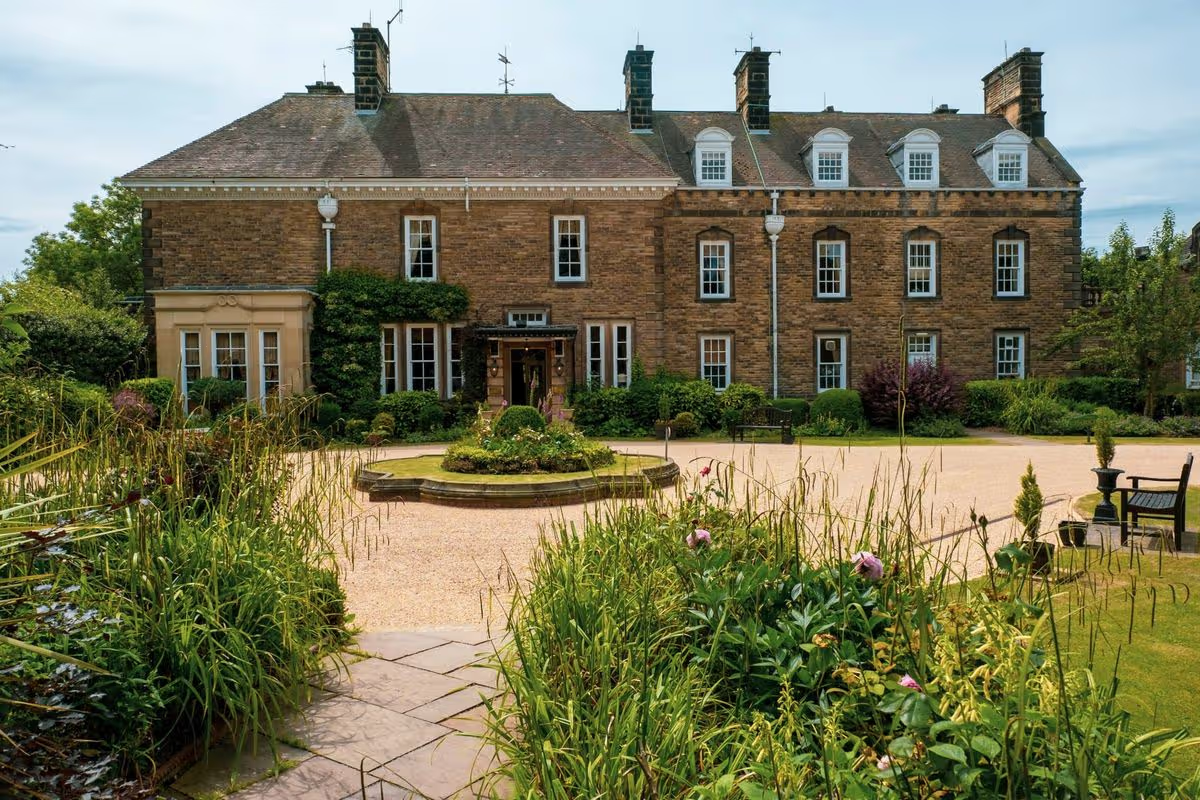
When an individual or an organization sets out to compare estate hotels, they often encounter a linguistic and conceptual trap. The term “estate” is frequently used as a marketing descriptor rather than a structural classification. In a rigorous sense, to compare these properties effectively, one must look at the “productive” nature of the land. A true estate hotel is often a working landscape—incorporating agriculture, viticulture, or conservation—whereas a resort is a consumption landscape.
Oversimplification in this field usually involves focusing solely on the guest room count or the presence of a spa. However, the true points of comparison lie in the property’s “Permeability” (how much of the land is accessible to the guest) and its “Heritage Integrity” (the degree to which the modern operation respects the original intent of the grounds). If a guest compares a 17th-century French chateau with a newly built 500-acre golf estate in Florida, the metrics for success are fundamentally different. One prioritizes the preservation of a singular architectural narrative; the other prioritizes the optimization of recreational flow.
The risk of poor comparison lies in ignoring the “Service-to-Land Ratio.” A property may have 5-star service within the walls of the main house, but if the surrounding 2,000 acres are neglected or inaccessible, the estate experience is effectively localized to a standard hotel stay. Therefore, the act of comparing these entities requires a dual-track evaluation: an assessment of the hospitality product and an audit of the land management strategy.
Deep Contextual Background: From Feudalism to Hospitality
The lineage of the estate hotel is inextricably linked to the history of land ownership and the decline of the landed gentry. In Europe, the progenitor was the “Stately Home,” a seat of political and economic power where guests were hosted not for profit, but for social and diplomatic leverage. As the costs of maintaining these massive structures became untenable in the early 20th century, many aristocratic families transitioned their homes into “country house hotels.” This shift preserved the architecture but fundamentally changed the social contract, moving from private invitation to commercial transaction.
In North America, the trajectory was different. The estate hotel evolved from the “Great Camps” of the Adirondacks and the coastal “cottages” of Newport. These were purpose-built for leisure, designed to provide the industrial elite with a sense of wilderness without sacrificing urban comfort. This created a precedent for the “Master-Planned Estate,” where the environment is curated specifically for the guest’s psychological ease.
Systemically, the transition to the modern estate hotel was accelerated by the global rise of “experiential travel.” The land itself became the amenity. Today, we see a convergence where European heritage sites are adopting American-style operational efficiency, and American resorts are seeking to manufacture the “heritage” feel through architectural mimicry and the establishment of local traditions. Understanding this evolution is crucial because it explains why a property feels the way it does; a converted monastery carries a different “weight” than a contemporary eco-estate, regardless of the similarities in their price points.
Conceptual Frameworks and Mental Models
To analyze these properties without falling into the trap of subjective aesthetic preference, we can apply several mental models:
-
The Ecosystem Services Model: This views the hotel as a part of its local environment. Does the estate contribute to the local ecology (e.g., through carbon sequestration or water management)? High-performing estate hotels function as stewards, and their value is tied to the health of the surrounding ecosystem.
-
The Heritage-Utility Paradox: This model measures the tension between preserving historical layout (which may be inefficient for modern service) and the need for contemporary luxury (high-speed internet, climate control). The best properties find a “Third Way” where the modern tech is invisible, yet the heritage is palpable.
-
The “Radius of Experience” Framework: Evaluation is based on how far the “hospitality bubble” extends from the bedroom. In a standard hotel, it’s a few hundred feet. In an elite estate, the hospitality should be felt even at the farthest boundary of the property—through trail maintenance, picnic services, or ranger-guided excursions.
Key Categories of Estate Hotels
Properties generally fall into one of the following archetypes, each with distinct trade-offs:
-
The Heritage Manor: Focuses on historical accuracy and “time-travel” immersion. Trade-off: Often lacks modern spatial optimization (small bathrooms, erratic layouts).
-
The Working Agrarian Estate: Includes vineyards, farms, or orchards. Trade-off: Operational noise and smells associated with agriculture can clash with “sanitized” luxury.
-
The Conservation Reserve: Thousands of acres dedicated to wildlife protection. Trade-off: High cost of entry and often remote locations requiring significant travel.
-
The Sporting Estate: Focused on specific activities like fly-fishing, hunting, or equestrianism. Trade-off: Can feel exclusionary or overly masculine in design.
-
The Wellness Sanctuary: The land is used for meditation paths, herb gardens, and silence zones. Trade-off: Strict rules on guest behavior (e.g., no phones in public areas).
-
The Architectural Showcase: Often a modern build by a “starchitect” that uses the land as a canvas. Trade-off: Can feel cold or “museum-like” rather than a home.
Comparative Matrix: Estate Types
| Category | Primary Value Driver | Land Use Intensity | Typical Staffing Focus |
| Heritage Manor | History/Architecture | Low (Garden focused) | Concierge/Butler |
| Agrarian Estate | F&B / Provenance | High (Productive) | Farmers/Chefs |
| Conservation | Seclusion/Nature | Very Low (Passive) | Rangers/Guides |
| Sporting Estate | Activity/Skill | Moderate (Managed) | Instructors/Grooms |
Real-World Scenarios and Decision Logic
When we compare estate hotels for a specific purpose, the “best” property changes based on constraints:
-
Scenario A: Multi-Generational Reunion. The primary failure mode here is “spatial boredom.” A small heritage manor might be too cramped. The decision logic dictates an Agrarian or Sporting Estate where diverse age groups can occupy different zones of the land simultaneously without feeling isolated.
-
Scenario B: Executive Retreat for High-Stakes Strategy. Here, the “Noise-to-Focus” ratio is the metric. A working farm might be too distracting. A Conservation Reserve provides the “psychological distance” from the city necessary for deep work.
-
Scenario C: Solo Creative Sabbatical. The “Heritage Manor” or “Wellness Sanctuary” provides the structured quietude needed. The failure mode is “Social Isolation”; these properties often provide communal dining or guided tours to mitigate this.
Planning, Cost, and Resource Dynamics
The financial model of an estate hotel is radically different from a high-rise urban hotel. In an urban setting, the “cost per square foot” is the dominant metric. In an estate, it is the “cost of land stewardship.”
Projected Operational Expense Distribution
| Expense Category | Percentage of OpEx | Drivers |
| Land Maintenance | 15% – 25% | Trail clearing, forestry, invasive species control |
| Logistics/Transport | 5% – 10% | Guest shuttles, internal fleet, remote sourcing |
| Labor (Specialized) | 30% – 40% | Botanists, historians, specialized instructors |
| Heritage Upkeep | 10% – 20% | Restoring stonework, period-accurate materials |
A guest must understand that they are not just paying for a room; they are subsidizing the preservation of a landscape. This is why estate hotels often feature “Resort Fees” or “Heritage Levies.”
Strategies and Support Systems for Evaluation
To effectively evaluate these properties, several specialized strategies can be employed:
-
The Site Audit: Beyond the digital brochure, reviewing satellite imagery provides an unfiltered view of land health and property density.
-
Historical Archive Access: Elite heritage estates often maintain archives. A property’s willingness to share its history indicates its commitment to authenticity.
-
Sustainability Certification: Looking for third-party verification of land management practices (e.g., LEED or regenerative farming certifications).
-
The Seasonal Variance Check: Evaluating how the estate functions in the “off-season” reveals its true operational resilience.
The Risk Landscape and Operational Failure Modes
Comparing estate hotels also means looking at what could go wrong. The risks are often “Compounding Risks”:
-
The “Disney-fication” Trap: When a property tries so hard to feel “historic” that it becomes a caricature. This destroys the authority of the estate.
-
Infrastructure Decay: A beautiful manor with failing 50-year-old plumbing. The aesthetic hides the systemic rot.
-
Ecological Mismanagement: Over-using the land (e.g., too many guests on a fragile trail) leads to long-term degradation of the very asset people are paying to see.
-
Operational Fragmentation: When the “farm” and the “hotel” are run by different teams who don’t communicate, leading to a disjointed guest experience.
Governance, Maintenance, and Long-Term Adaptation
The longevity of an estate depends on its governance structure. This includes:
-
Conservation Easements: Legal frameworks that protect the land from future development.
-
Restoration Review Cycles: Scheduled 5-to-10-year audits of architectural integrity.
-
Adaptive Reuse Strategy: A plan for how old buildings (barns, stables) can be repurposed for modern guests without losing their character.
-
Layered Maintenance Checklist: Daily landscape grooming combined with decadal structural assessments.
Measurement, Tracking, and Evaluation Metrics
A sophisticated evaluator uses leading and lagging indicators to judge an estate’s health:
-
Qualitative (Leading): Is the staff-to-guest ratio consistent across the entire acreage, or just in the lobby?
-
Quantitative (Lagging): Percentage of food sourced directly from the estate’s own soil.
-
Documentation Examples: A world-class estate should be able to provide a “Land Management Plan,” a “Biodiversity Census,” or a “History of Restoration” document. This proves they are stewards, not just landlords.
Common Misconceptions and Oversimplifications
-
“Bigger is always better”: A 10,000-acre estate that is poorly managed feels smaller and more restrictive than a 50-acre estate where every square inch is curated.
-
“Old means authentic”: Many “historic” estates were heavily renovated in the 1980s, losing their original soul. Conversely, some new builds are more historically accurate in their philosophy than genuine old buildings.
-
“Estate hotels are only for the wealthy”: While the entry price is high, the “value-to-time” ratio is often better than urban luxury, as the activities and environment are included.
-
“They are always remote”: Some of the world’s finest estates are within 60 minutes of major capitals, offering “accessible seclusion.”
Synthesis and Future Adaptability
The endeavor to compare estate hotels is, at its core, an exercise in valuing the integration of human comfort and natural or historical environments. The definitive estate hotel is not merely a place to sleep; it is a repository of culture, a guardian of the landscape, and a complex operational machine. As the hospitality industry continues to evolve toward hyper-personalization and environmental accountability, the properties that will endure are those that treat their land not as a backdrop, but as a living participant in the guest’s journey. When choosing or analyzing these assets, look for the threads of continuity—between the past and the present, the house and the garden, and the service and the soil. That is where the true authority of an estate lies.